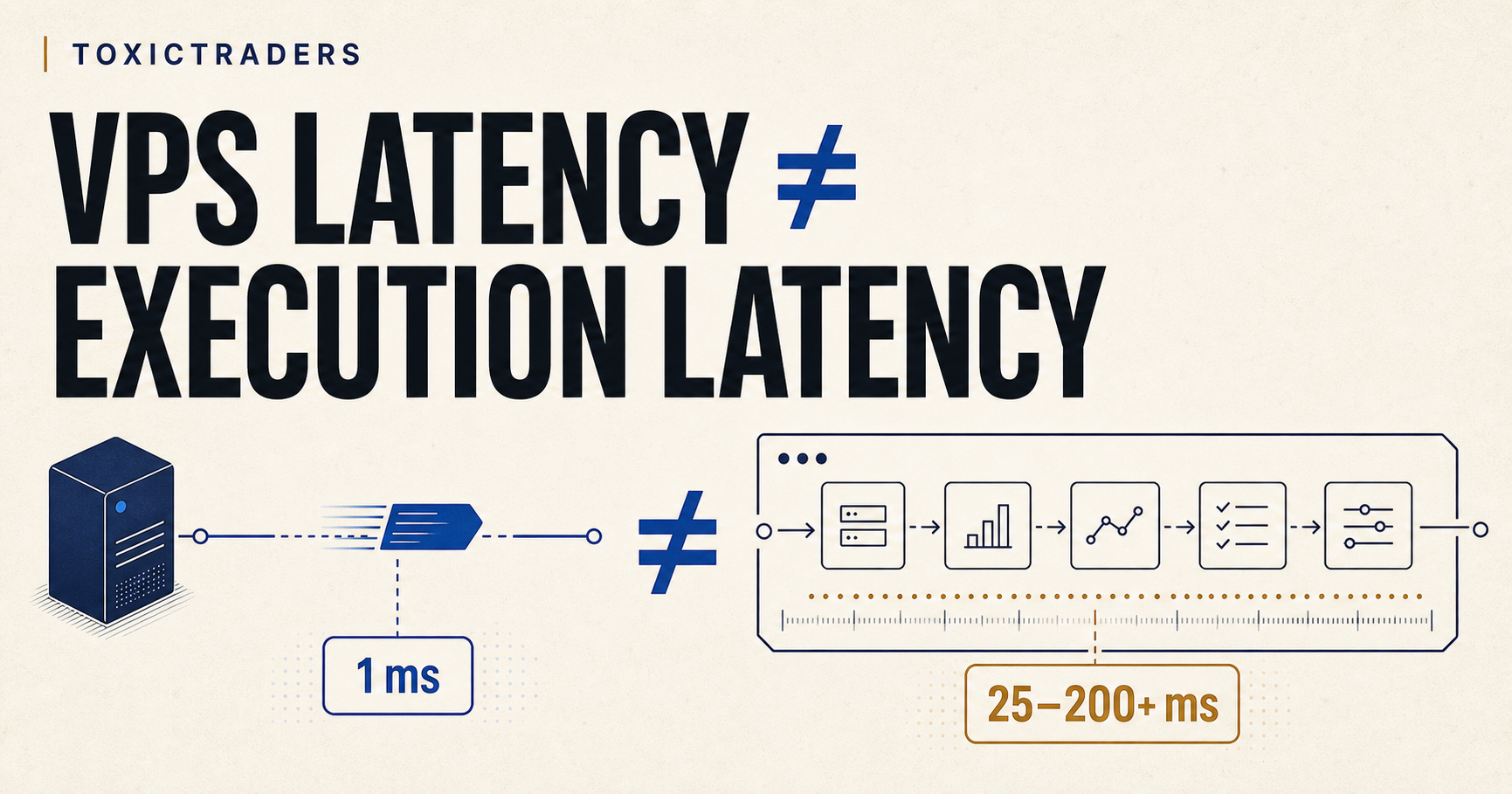
A Forex VPS is often marketed as if the provider with the lowest advertised ping will automatically deliver the best trading execution. Our experience does not support that conclusion.
If you are new to the full release-to-order workflow, start with our introduction to macro news trading. This guide focuses on the infrastructure between the trading client and broker.
We have used or tested infrastructure from UltraFX, BeeksFX, OVH, Vultr, ForexVPS, Hyonix, and other providers in London and New York. For the news-trading workloads we monitored, the reputable providers generally delivered similarly low latency and stable networking when their servers were placed near the same broker infrastructure.
The differences between them were frequently measured in tenths of a millisecond. Broker order processing, meanwhile, normally took tens of milliseconds and could take considerably longer during an economic release.
This changes the VPS selection problem. The objective is not to buy the most expensive product with the word “trading” in its name. The objective is to place a stable machine close to the broker's trading server, provide enough CPU and RAM for the trading workload, and avoid paying a large premium for a network difference that is unlikely to determine the final execution result.
Why Use a VPS for News Trading?
The reason latency matters at all is the shape of a macro release: the first repricing is finished in seconds, as described in what macro news trading is. Everything below concerns one segment of that path.
In our setup, the VPS keeps the path between the trading signal, the trader's client application, and the broker's trading server as short and stable as possible.
A correctly located VPS can reduce this network segment to approximately 1–3 ms for suitable broker-server routes. It also allows the trading client to remain online independently of a home computer, residential internet connection, and local power supply.
The practical benefits are:
- proximity to the broker's trading server;
- stable network routing;
- continuous operation;
- independence from the trader's home connection;
- the ability to keep trading applications running remotely;
- consistent conditions for measuring execution.
A VPS does not make the news signal faster by itself. It affects the client-to-broker part of the chain. If the signal or news feed is delayed, moving the trading client closer to the broker cannot recover the time already lost before the order was created.
VPS Latency and Execution Latency: How We Measured Them
The most important distinction is between network latency and broker execution latency.
In our comparisons, network latency was measured with high-resolution operating-system timing around TCP connection establishment to the broker's trading server. This is more relevant to our use case than measuring the route to the VPS provider's website or a generic datacentre test address.
Broker execution latency was measured separately as the time between transmitting the order request and receiving the broker's confirmed result.
These values describe different parts of the process:
VPS network latency → time associated with reaching the broker server
Execution latency   → time until the broker returns the order result
A VPS may show a connection latency below 1 ms while the broker still takes 20, 50, 200, or more milliseconds to process the order.
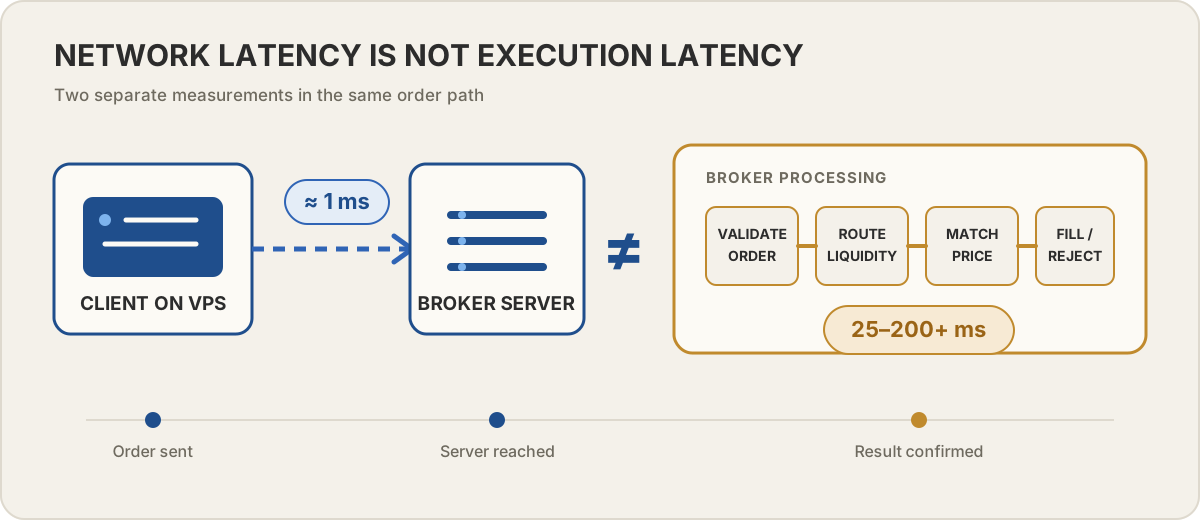
The approximately 1 ms network segment and the broker's 25–200+ ms processing segment are separate measurements. Neither guarantees a particular fill price or result.
Does 0.5 ms vs 1 ms Matter?
For the web platforms, desktop trading terminals, and account connections we have monitored, the difference between 0.5 ms and 1 ms to the broker server was not the decisive factor.
Across comparable London and New York locations, differences between VPS providers were commonly around 0.1–0.3 ms. These differences were much smaller than the broker-processing time recorded after an order reached the trading server.
Because our system is designed for release trading, we do not use quiet-market orders as the primary execution benchmark. During economic releases, the minimum execution results in our observations were generally 25 ms or higher across the broker connections tested.
This summary is based on approximately five years of observations covering about 50 broker connections. It is historical experience from our own environment, not a promise of current or future performance from any broker or VPS provider.
The conclusion is straightforward:
Once network latency is already low and stable, reducing it by another fraction of a millisecond is usually less important than broker processing, signal quality, liquidity, spread, and slippage.
Our Experience with Forex VPS Providers
UltraFX
We used UltraFX infrastructure in New York and London for approximately one year. The network latency was low and suitable for the tested broker routes.
The reason for moving away was not poor connectivity. CPU and RAM were expensive relative to the resources offered, while the measured latency was effectively the same as the less expensive Hyonix locations we later used.
BeeksFX
Our practical conclusion with BeeksFX was similar. The network was suitable for trading, but the premium price did not produce a meaningful latency advantage for our news-trading workload compared with correctly located general-purpose infrastructure.
OVH, ForexVPS, and Other Providers
OVH, ForexVPS, and the other providers we evaluated also delivered broadly similar results when the location and broker route were comparable. We did not find a provider-level advantage large enough to override location, available resources, and price.
Vultr
Vultr has one operational advantage for temporary use: hourly billing.
This can be useful for a trader who wants to rent a machine for only two or three hours around a specific event rather than keep a Windows VPS for an entire month. For a continuously running trading client, monthly infrastructure may be simpler, but hourly billing gives short-term users more flexibility.
| Provider | Tested locations | Approx. broker ping | Price tested | Practical conclusion |
|---|---|---|---|---|
| BeeksFX | London, New York | 1 ms | GBP 55/month | Suitable network, but the price was high for comparable latency and resources. |
| UltraFX | London, New York | 1 ms | EUR 65/month | Suitable network, but the price was high for comparable latency and resources. |
| Vultr | London, New York | 1 ms | USD 51/month equivalent | Similar latency; hourly billing remains useful for temporary event-based use. |
| OVH | London, New York | 1 ms | CAD 70/month | Similar latency, but the price-to-resource ratio did not fit our requirements. |
| Hyonix | London, New York | 1 ms | USD 24/month | The best price-to-resource fit for our current workload. |
Prices are the amounts we tested or paid for the relevant configurations, not a live price comparison. Plans and exchange rates can change.
Why We Currently Use Hyonix
We currently use Hyonix in London and New York and have used the service for approximately two years.
Our choice was based on three practical factors:
- suitable locations near the broker infrastructure we use;
- strong network connectivity through Equinix facilities;
- a favourable price for the available CPU and RAM.
Hyonix publicly lists its London service in Equinix LD8 and its New York service in Equinix NY2/NY4. The provider also publishes test IP addresses for its locations, allowing a customer to examine the route before ordering. See the Hyonix locations and plans. These provider details and the plan specifications below were checked on July 16, 2026.
During our two years of use, we have not experienced a service outage, unexpected restart, or network problem that affected our setup. We also have no practical experience with Hyonix support because we have not needed to contact it.
This personal history is not the same as an audited uptime measurement. Hyonix's current Terms of Service state a 99.99% uptime guarantee for network and host-node availability, subject to the listed exclusions. See the Hyonix service terms.
We pay the normal retail price. Hyonix currently publishes an affiliate programme, but we do not participate in it, use a referral link, receive a discount, or have a sponsorship relationship with the provider.
This article is not sponsored. We pay for the infrastructure we use.
We originally found the provider while researching peering and network availability around Equinix facilities in New York, rather than through a Forex VPS advertisement.
Location Comes Before the Provider Name
A VPS should be selected for the broker server actually used by the trading account.
“New York” or “London” alone is not precise enough. A city can contain multiple datacentres and many independent network routes. Two machines in the same metropolitan area can have different latency, jitter, and packet loss to the same broker endpoint.
Before ordering a VPS:
- identify the broker's relevant trading server;
- identify the likely server region;
- obtain test IP addresses from candidate VPS providers;
- test the route from the location being considered;
- measure the connection to the broker server from the VPS itself;
- compare stability, not only the lowest single reading.
The provider's looking-glass or test IP is useful for initial screening, but the final measurement should be made between the deployed VPS and the trading server used by the account.
CPU and RAM Still Matter
Low network latency is not useful if the VPS is overloaded.
Trading terminals, browser-based platforms, chart windows, log processing, and multiple account connections consume CPU and memory. An oversubscribed or undersized VPS can freeze, delay the client application, or create inconsistent local processing even when the network route is excellent.
For this reason, VPS selection should include:
- CPU performance, particularly when applications depend heavily on one thread;
- sufficient RAM for every terminal and account connection;
- enough free memory to avoid paging;
- stable storage for logs and application updates;
- capacity for the expected peak workload rather than only idle usage.
Our current Hyonix configuration costs $24 per month and provides:
- 4 vCPU;
- 8 GB RAM;
- 100 GB NVMe storage;
- Windows Server 2019.
One client process manages 20 trading accounts. Under the normal workload, it uses approximately 5–7% CPU and about 2 GB of RAM. This leaves substantial capacity for operating-system overhead, temporary load increases, logs, and future account growth.
The client uses its own ports and application protocols, so it does not require a separate terminal process for every account. Application-level protocol protection should not be confused with network-level DDoS mitigation, which remains part of the hosting provider's infrastructure.
The correct specification depends on the actual workload. A single lightweight client and dozens of active terminal sessions should not be given the same recommendation.
What a VPS Cannot Fix
A VPS can reduce and stabilise one network segment. It cannot repair problems elsewhere in the trading chain.
It cannot fix:
- a delayed or poor-quality signal;
- a slow news feed;
- slow broker processing;
- limited market liquidity;
- a widening spread;
- slippage;
- order rejection;
- an incorrectly configured trading rule;
- a broker route that is geographically distant from the selected VPS.
Nor does it choose how you enter: the same connection serves a pending stop order, a trigger-based system or a manual click very differently, and the comparison of execution methods covers what each one needs from the infrastructure below it.
This is why selecting a VPS only by its advertised ping creates unrealistic expectations. A 0.5 ms connection does not guarantee a fast fill, the requested price, or a profitable result.
For a concrete example, inspect two losing news trades despite 1 ms broker ping. Their recorded gold ticks show why the entry price and subsequent market move matter even with a short network path. The case study also separates measured order execution from signal delay, which these order records do not establish.
Measured latency only becomes meaningful next to filled prices; the per-event execution telemetry on our verified results is published for that comparison.
Do You Need a Backup VPS?
We do not currently use a backup VPS for this client setup. In our experience, the primary Hyonix instances have been stable, and adding a second active machine would introduce additional operational concerns, including the risk of duplicate order transmission if failover were designed incorrectly.
That does not mean redundancy is unnecessary for every trader or service. A backup becomes more relevant when a workload has strict availability requirements and includes a tested mechanism for state synchronisation, health checks, and duplicate-order prevention.
For an individual trading client, an untested second VPS can create more risk than it removes.
A Practical VPS Selection Checklist
Before paying for a specialised Forex VPS, check the following:
Network
- Is the VPS close to the actual broker trading server?
- What is the TCP latency from the deployed VPS to that server?
- Is the result stable across repeated measurements?
- Are jitter and packet loss acceptable?
Execution
- What execution latency does the broker return during economic releases?
- How does that result compare with the TCP connection latency?
- Is the VPS difference large enough to matter relative to broker processing?
Resources
- Is the CPU sufficient for the trading applications?
- Is there enough RAM without paging?
- Can the VPS handle all terminals and account connections simultaneously?
- Is the higher-priced trading package providing real resources or only branding?
Operations
- Does the provider offer a useful trial or refund period?
- Is hourly billing more suitable than a monthly subscription?
- Is the Windows licence included?
- Are the location, network, and uptime terms documented?
Commercial relationship
- Is the recommendation sponsored?
- Is an affiliate commission involved?
- Are the published results based on actual use or only provider marketing?
Conclusion
The best VPS for low-latency news trading is not necessarily the provider with the lowest advertised ping or the highest price.
Based on our experience across London and New York, reputable providers placed near the same broker infrastructure produced very similar network results. Differences of 0.1–0.3 ms were small compared with broker execution times measured in tens of milliseconds.
Our current choice is Hyonix because its London and New York locations, Equinix connectivity, resource pricing, and observed stability fit our workload. This is a practical choice for our infrastructure, not a claim that one provider is universally best for every broker and every trader.
Choose the location based on the broker server, verify the route yourself, allocate enough CPU and RAM, and measure execution separately from network latency. Once a stable 1–3 ms broker route has been achieved, the quality of the signal, the broker, liquidity, spread, and slippage are likely to matter more than another fraction of a millisecond.
Related Reading and Methodology
- See What Is Macro News Trading? for the complete path from official release to confirmed order execution.
- Review how we measured network and execution latency before comparing VPS claims.
- Read the ToxicTraders risk disclosure for the execution and market risks that a low-latency VPS cannot remove.
- Return to the ToxicTraders platform overview to see where the VPS fits into the full system.
This material is provided for educational purposes and is based on our practical infrastructure and execution observations. Historical latency and uptime do not guarantee future performance. Nothing in this article is investment advice or a promise of trading results.